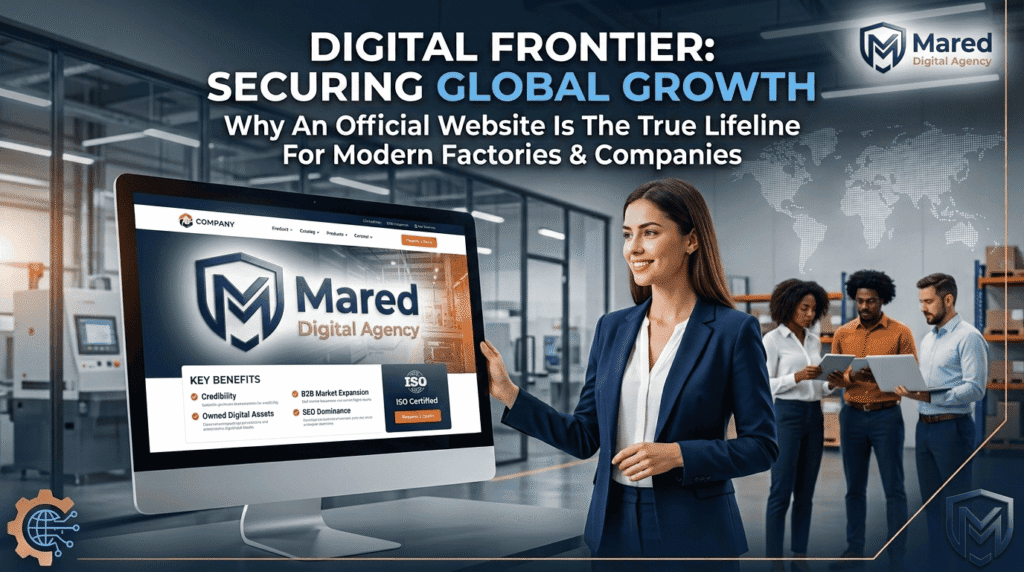
Why Every Factory and Company Needs an Official Website
In today’s era of rapid digital transformation and accelerated business cycles, the core strategic question facing enterprise leaders and manufacturers is no longer “Do we need a website?”, but rather: “How can we build a high-performance website that secures our local and global market leadership?”
A corporate digital presence is now the primary venue for conducting commercial transactions across both B2B and B2C sectors. An official website is no longer a passive luxury or a static online brochure; it is your company’s most influential headquarters and a primary branch that never closes its doors.
1. Building Brand Authority & Credibility
Imagine a potential corporate client, investor, or procurement manager hearing about your company or manufacturing facility. What is their immediate first step? They head directly to global search engines like Google.
-
A Sustainable First Impression: The absence of an official website in search results conveys an indirect impression of limited capacity, lack of modernization, or small operational scale.
-
An Official Source of Truth: A website provides a trusted, centralized platform to showcase your company profile, product catalog, and quality certifications (such as ISO standards) without the noise or volatility of social media networks.
2. Expanding Into International Markets & Crossing Geographic Borders
For factories and industrial producers in particular, the web offers unlimited opportunities to reach international buyers, distributors, and commercial agents without incurring exorbitant physical expansion costs.
“A multilingual, Search Engine Optimized (SEO) website acts as your most efficient global sales representative—working 24 hours a day, 7 days a week to market your production lines to buyers around the world.”
-
Capturing B2B Deals: Global importers and procurement directors routinely research certified suppliers online before initiating contact or issuing requests for proposals.
-
Precision Targeting: High-performing websites leverage international and localized keyword targeting strategies to penetrate specific geographical markets and demographics with high intent.
3. Complete Independence & Owned Digital Assets
Relying exclusively on third-party social media platforms (such as Facebook, LinkedIn, or Instagram) represents a critical strategic risk often referred to as “building on rented land.”
-
Absolute Operational Control: Social media algorithm changes or sudden account suspensions can instantly sever communication with your client base. Conversely, your website is a fully owned digital asset.
-
Proprietary First-Party Data: An owned website enables detailed analytics, helping you monitor visitor behavior, evaluate product interest, and gather actionable data to guide future strategic decisions.
4. Reducing Operational Overhead & Enhancing B2B Support
An integrated corporate portal significantly reduces routine operational burdens for sales and customer support teams within manufacturing facilities:
-
Digital Catalogs & Technical Specs: Instead of printing costly physical brochures that quickly become outdated, you can offer downloadable PDF catalogs, technical data sheets (TDS), and CAD specifications directly.
-
Comprehensive FAQ Architecture: Provide instant, structured answers regarding ordering workflows, shipping terms, quality assurance protocols, and Minimum Order Quantities (MOQ).
-
Automated RFQ Systems: Enable prospective buyers to submit detailed Request for Quotation (RFQ) forms effortlessly, streamlining sales lead generation.
5. Sustainable Competitive Advantage Through SEO
Ranking on the first page of global search engines when potential clients search for manufacturing services or commercial products ensures you capture market share long before competitors even enter the conversation.
| Strategic Metric | Paid Advertising (PPC) | Search Engine Optimization (SEO) |
| Continuity | Traffic drops to zero immediately when budget ends. | Delivers sustainable, compounding organic traffic over time. |
| Cost Structure | Recurring, escalating ad spend per click. | Upfront strategic investment that lowers Customer Acquisition Cost (CAC). |
| Buyer Trust | Often perceived as a commercial promotion. | Organic search rankings are viewed as highly credible and authoritative. |
Essential Criteria for a High-Converting Website
To ensure your corporate website drives real commercial growth and measurable ROI, it must incorporate the following foundational pillars:
-
Mobile Responsiveness & Speed: Flawless user experience across all devices with ultra-fast page load times to reduce bounce rates.
-
Intuitive UI/UX Design: Clear navigation, logical product categorization, and accessible technical documentation.
-
Strategic Calls-to-Action (CTA): Prominent conversion points such as “Request a Quote”, “Download Specification Sheet”, or “Contact Sales”.
-
Comprehensive On-Page & Technical SEO: Optimized metadata, schema markup, and high-intent commercial keyword alignment for top search engine visibility.
Conclusion
Owning an official, professionally engineered website is no longer an optional tactic for factories and enterprises—it is the cornerstone of modern business continuity, global scaling, and brand equity. Operating without a powerful web presence leaves the market open for competitors to capture your potential clients. Investing in your digital infrastructure today turns your web presence into an active revenue-generating asset for years to come.